
RV Prep for a Long Road Trip: Getting Ready for a 5-Month Yukon Adventure

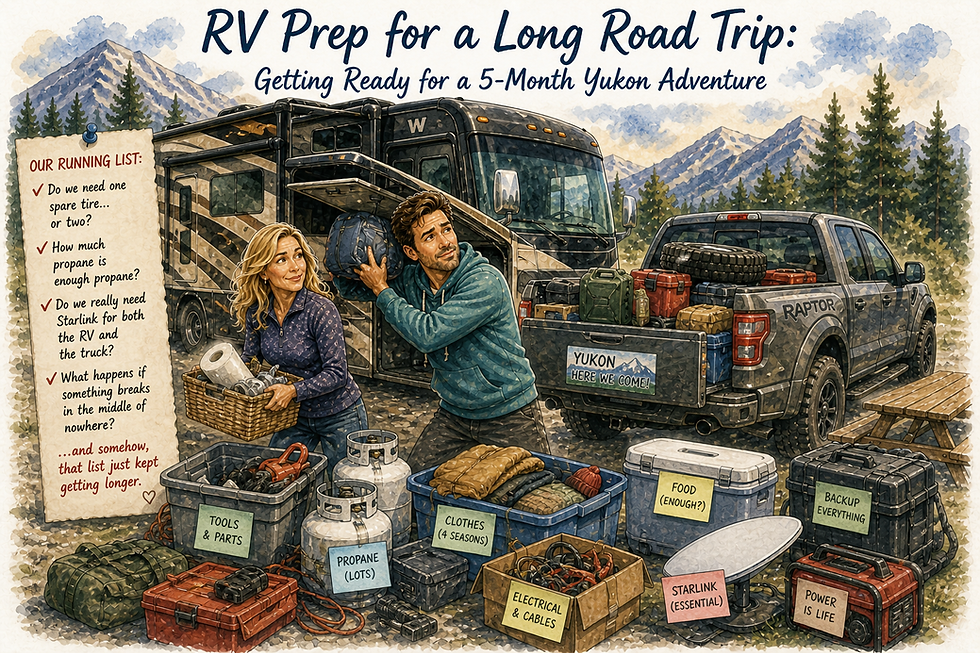
There’s a moment before every big trip where the excitement starts to mix with a little bit of… what are we forgetting?
Before this journey, I had a running list in my head that sounded something like this:
Do we need one spare tire… or two?
How much propane is enough propane?
Do we really need Starlink for both the RV and the truck?
What happens if something breaks in the middle of nowhere?
And somehow… that list just kept getting longer.
Planning a 5-month RV trip to the Yukon has a way of doing that to you.
Because it’s not just about mapping routes and booking campgrounds—it’s about trying to prepare for things you can’t fully plan for. The breakdown that happens miles from anywhere. The freezing night when something stops working. The “we didn’t think of that” moment.
At some point, though, you have to stop asking “what if” and start deciding what you’re actually going to do about it.
This is how we approached prepping for this trip—and what we’ve already learned just a few weeks into the adventure.
Step One: Define Your Risks

Start by separating your concerns into two categories:
Biggest Fears
1. Mechanical failure that creates safety concerns
2. Breakdowns that leave you stranded
3. Natural disasters (fires, storms, extreme weather)
Annoyances
4. Trip delays
5. Lost campground reservations
6. Appliance failures (refrigerator, heat, AC)
The goal is to prepare for both—but focus most of your energy on your top three fears.

Layer 1: Prevention
If you’re going to take a big RV on a big adventure, you need to accept big maintenance.
For us, that meant:
· Staying current on maintenance and following through on recommended repairs
· Replacing tires proactively (ours were 6–7 years old)
· Replacing house batteries before they became an issue
· Handling the “boring” tasks like roof checks, AC lines, and generator service
Prevention allows you to control the timing, location, and cost of maintaining your RV.
Layer 2: Planning
Planning isn’t about avoiding problems—it’s about being ready for them.
· Roadside assistance matters (we chose Coach-Net)
· Understand towing requirements for a Class A diesel
· Plan RV-safe routes—not fear-based ones
Layer 3: Flexibility on the Road
· Don’t ignore warning lights
· Monitor weather constantly
· Don’t prioritize schedule over safety
Minimizing Annoyances (Plan B & C Thinking)

Backup Heat Saved Us
We almost didn’t bring a small ceramic heater.
Then one night in South Dakota:
· Temps dropped to 30°F
· We ran out of propane
· The heat pump didn’t work below 40°F
We turned on the electric fireplace and added the ceramic heater—and were warm in minutes.
That heater now has a permanent spot in our RV.
Be Ready for Workarounds
· Rain gear near the door
· Backup fridge/freezer option
· Portable AC
· Amazon + small-town delivery
Connectivity & Communication
· Starlink → Primary connection
· T-Mobile hotspot → Backup
· Cell booster → Limited improvement
Knowledge Is Power
· Owner groups specific to your RV
· Local RV park staff
· AI tools (helpful but not perfect)
· Your own RV “cheat sheet”
Real Life: What We’ve Already Faced
· Alternator failure → Fixed same day
· Fireplace motor failure → Diagnosed and replaced
· Weather reroute → Lost reservation but stayed safe
· Water system issue → Learning curve with pump
· Ran out of propane → Backup heat saved us

Final Thoughts


Comments