
Yellowstone Feels Alive


More Than Just Wilderness
Yellowstone already feels almost impossible to comprehend before you ever step onto a boardwalk.
The park alone contains enough mountains, rivers, waterfalls, wildlife, forests, and wilderness to leave most visitors overwhelmed in the best possible way. You can spend days simply watching bison move across valleys, hiking through alpine landscapes, or standing beside roaring waterfalls and still leave feeling like you barely scratched the surface.
And then Yellowstone adds something else entirely.
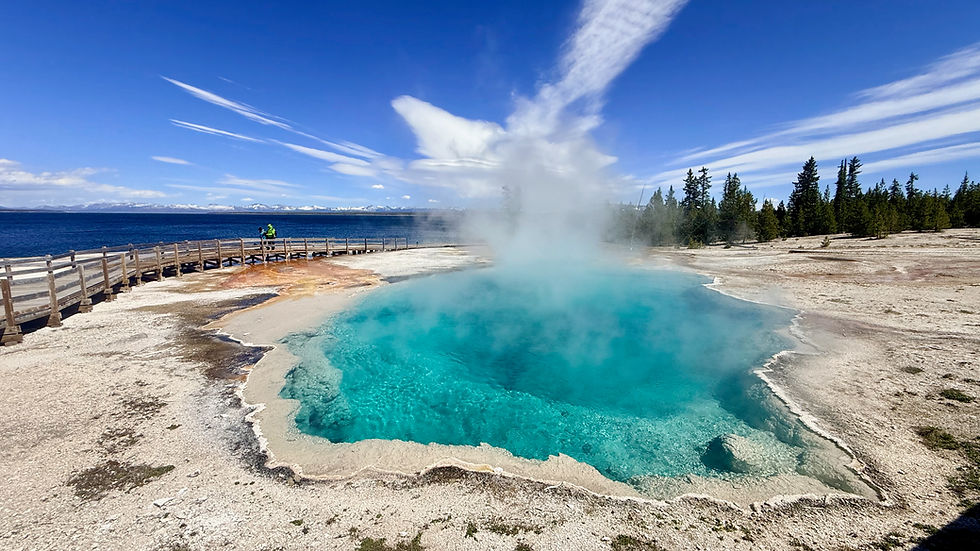
Steam rising from the earth.Boiling pools of impossible color.Mud bubbling from underground chambers.Geysers erupting into the sky.Sulfur drifting through the air.Entire hillsides hissing and breathing as if the earth itself is alive beneath your feet.
It almost feels unfair that one place can contain all of this at once.


A Living Landscape
Yellowstone sits above one of the largest volcanic systems in the world — a massive underground heat source that still actively powers the park’s geothermal features today. While the term “supervolcano” captures people’s attention, what visitors actually experience is something much more immediate and fascinating: a living landscape constantly changing in front of them.
Nothing here feels static.
The pools steam differently depending on the weather and temperature. Colors shift with sunlight and moisture. Water levels rise and fall. Steam drifts through the trees one moment and clears the next. Some mornings the geothermal basins feel mysterious and hidden beneath fog, while other days the bright colors explode against deep blue skies in ways that almost seem artificial.
But they are not artificial.
That may be one of the most remarkable parts of Yellowstone.

Natural Wonders Beyond Imagination
Walking along the boardwalks at places like Mammoth Hot Springs, Grand Prismatic Spring, Norris Geyser Basin, or Old Faithful, it is easy to forget that these places are not carefully designed exhibits or man-made attractions. The turquoise pools, steaming terraces, colorful bacterial mats, mineral formations, and boiling springs all exist naturally — shaped slowly over thousands of years by heat, water, minerals, weather, and time.
At times, Yellowstone feels less like a national park and more like another planet somehow hidden inside the Rocky Mountains.
This trip, several geothermal areas — including parts of Biscuit Basin — were temporarily closed following the unusual bear incidents earlier in the season. But Yellowstone is so immense and filled with geothermal wonders that even closures barely scratch the surface of what there is to experience.
Slow Down and Experience It

And experience is the key word.
Yellowstone’s geothermal areas are not places you rush through successfully.
There are simply too many moments where the beauty forces you to slow down.
Grand Prismatic Spring is a perfect example. Most visitors walk the boardwalk beside the spring, admire the colors briefly, take a few photos, and move on. But some of the most unforgettable views come only after climbing the trail above the basin and looking down across the enormous rainbow of steam, water, and color from above.
It is not a view you fully absorb in thirty seconds.
Some places need time.
Yellowstone often feels less like sightseeing and more like standing quietly in front of a painting that slowly reveals new details the longer you remain there.
And the park rewards those willing to give it that time.
Colors, Steam, and Constant Change


The colors alone can feel surreal — bright oranges, deep blues, glowing greens, creamy whites, rust reds, and vivid yellows flowing together through steaming channels and terraces. Water spills from springs into streams and rivers that almost seem unreal in certain light conditions.
Photographs rarely capture what it actually feels like standing there in person.
Many of these geothermal features are constantly interacting with the weather around them. Steam drifts across pools and terraces differently every hour, sunlight changes the intensity of colors, and fog can transform an entire basin into something mysterious and dreamlike.
Nothing feels stagnant here.
Everything feels alive.
More Than Just Nature
But slowing down in Yellowstone is not just about moving physically slower.
It is about letting go of the constant mental noise most of us carry every day.
Yellowstone has a way of forcing you into the present moment.
There is little cell service in much of the park. Emails stop arriving. Notifications disappear. Conversations become less distracted. You begin noticing things you normally overlook — shifting clouds, distant steam, changing light, the sound of water moving beneath boardwalks, or the silence that exists between geothermal eruptions.
And somehow, in the middle of all this overwhelming natural beauty, you reconnect not only with nature — but with the people experiencing it beside you.
That may be Yellowstone’s greatest gift of all.
Not simply showing you extraordinary places…
…but reminding you how to actually experience them.




Comments