
Finding Your Travel Rhythm

There’s a rhythm to traveling—just like there’s a rhythm to everyday life.
And when your travel rhythm doesn’t match the people you’re traveling with… things can get a little tense.Kind of like roommates who seemed like a great idea at first… until they weren’t.
Over the years, I’ve realized there are a few common types of travel rhythms—and most of us fall somewhere in between.
1. The Destination Traveler

This is the “get there” traveler.
Long driving days, minimal stops, eyes on the prize. The goal is simple: get to the destination as quickly as possible so you can spend more time enjoying it.
There’s definitely a payoff—you often get to stay longer once you arrive. But the downside?You’re usually exhausted when you get there… and the return trip is already looming in the back of your mind.
2. The “Go Where the Road Takes You” Traveler

This is the free spirit.
You might have a general direction in mind, but schedules? Not your thing. You love flexibility, backroads, spontaneous stops, and figuring things out as you go.
It sounds ideal—and sometimes it is—but it can also mean ending up in less-than-great campgrounds or scrambling for a place to stay on busy weekends.
This style works best when you have a smaller, more flexible setup. Big rigs… not so much.
3. The “Stay on Schedule” Traveler

Everything is booked. Everything is planned.
This traveler wants to see it all—and makes sure nothing gets missed. It’s efficient, organized, and can work really well… as long as everything goes exactly as planned.
But travel rarely works that way.
Sometimes you find a place you love and want to stay longer. Sometimes things don’t go as expected. And when there’s no flexibility, even one small change can throw everything off.
4. The “Always Moving” Traveler
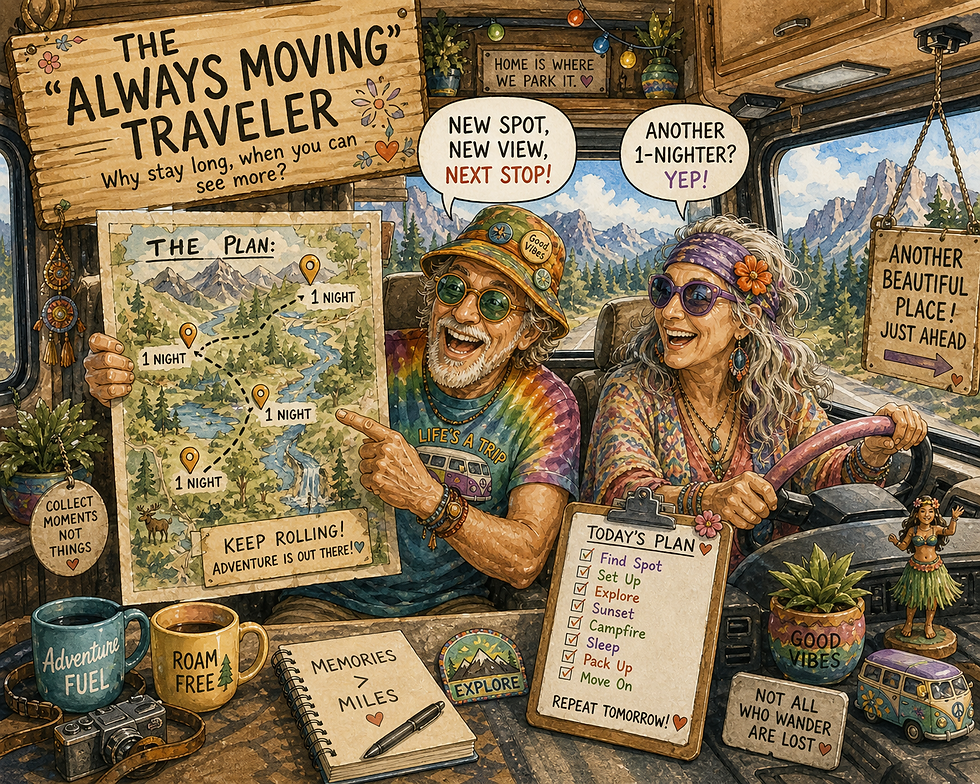
(We jokingly call this the ADD traveler… because it fits us pretty well.)
This is the traveler who stays a night or two, then moves on. You see a lot, cover a ton of ground, and you’re never bored.
At first glance, it sounds perfect.
But without some built-in downtime, fatigue sneaks up on you. And sometimes the best parts of travel happen when you slow down—chatting with locals, wandering through a small museum, or just sitting still long enough to take it all in.
What We’ve Learned
None of these travel styles are right or wrong.
But understanding them—and respecting them—is important.
Know your own rhythm
Understand your travel partner’s rhythm
And try to match your trip to both
Because when those things are out of sync, the experience can suffer.
Our Rhythm (and How It’s Changed)

We naturally lean toward the “always moving” style.
I love backroads. I’ll go out of my way to avoid highways, even if it adds time. There’s just something about the slower pace, the small towns, and the unexpected stops along the way.
But I’ve learned that sometimes… that’s not the best choice.
Getting to Yellowstone before Memorial Day crowds? That mattered.Driving a 42-foot RV on questionable backroads? Also matters.
We’ve had a few “that was not a good idea” moments—tight turns, narrow roads, stressful campground entrances—that definitely made me rethink things.
I’ve also learned that mileage means nothing without context.
50 miles on a winding mountain road can be far more exhausting than 200 miles on a flat freeway.
Slowing Down (On Purpose)
We used to travel with a bit of a schedule mindset:
Drive every day.Stay one night.Push until we reached a “destination”… then stay a few days.
But that meant passing by a lot of places we might have loved—without even realizing it.
Now, we do things differently.
Shorter driving days
More 2-night (or longer) stops
Built-in time to explore, golf, hike, or just breathe
I even book more nights than I think we’ll need.
Because once we settle into “adventure mode,” we stop trying to control every minute… and start enjoying where we are.
And those extra days?They become incredibly valuable when plans shift (which they always do).


Comments