
Whitehorse to Dawson City: The Road Less Traveled

Updated: Aug 5

Getting to Whitehorse along the Alaska Highway had been every bit as good as we'd hoped. The roads were generally excellent, traffic was lighter than we'd expected, we enjoyed some memorable wildlife sightings, and around nearly every bend the scenery seemed to change yet again.
Whitehorse is where the journey changes
We spent two nights in the "metropolis" of Whitehorse—and yes, after weeks of northern highways, it actually felt like one.
We "provisioned up" at the Canadian Superstore, picked up a few things at Canadian Tire, found a little local restaurant for dinner, and wandered along the Yukon River waterfront simply taking it all in.

Not sure which was funnier—that we genuinely enjoyed the comfort and ordinariness of being in a "big city," or that after weeks in the North we actually thought Whitehorse qualified as one.
Funny how quickly your perspective changes.
A few traffic lights, a Costco-sized grocery store, and a choice of restaurants suddenly felt like luxury.
Whitehorse was also the last place on this trip that felt comfortably familiar. We had one more good meal, one last fully stocked grocery store, and one last chance to buy anything we might need before heading into an even more remote part of the Yukon.
The Alaska Highway continues west through Haines Junction toward Tok and the heart of Alaska. Most travelers simply keep going.
We didn't.
Klondike Highway

Instead, we pointed the motorhome north onto the Klondike Highway toward Dawson
City—a road that felt far less traveled and, according to just about everyone we met, much rougher. More than one local warned us these were the worst road conditions they'd seen in fifty years.
Oh joy...
Suddenly, it felt like we were leaving the familiar behind and heading into a very different Yukon.
As Whitehorse disappeared in the mirrors and the wilderness took over once again, we noticed something else. The big Class A motorhomes were becoming increasingly rare. Most of the RVs heading north were camper vans, truck campers and smaller trailers. They looked nimble, quick and almost stealthy compared to our big, fat, unbendable 44-foot motorhome.
It didn't take long to understand what everyone had been talking about.
The construction began.

Miles and miles of steel-plate sections that rattled, shook and bounced every cabinet in the coach. Dust everywhere. Then came the first pilot car.
"Maybe this will be better."
It wasn't.
Now we added mud, deep ruts and massive highway equipment to dodge for what seemed like forever. When the pilot car finally released us, we thought we were through the worst of it.
We weren't.
There were still more miles of rough dirt before the pavement finally returned.
Eventually we rolled into Pelly Crossing.
I'll admit it—we were already second-guessing our decision and dreading the drive back.
Fortunately, our riverside campsite and a relaxing evening around the campfire reminded us why we'd come north in the first place. For a little while, we felt like pioneers ourselves.
Found a nice Riverview site on Pelly Creek and enjoyed the views. Note There is a Lot of time to enjoy the view as the sun doesn't set until almost 1:00am and it really never got dark.
The next morning we set off again.
Halfway there.
Surely the worst was behind us...
Hmm.

Instead we were introduced to frost heaves and potholes that looked more like small craters than imperfections in the road. Just when we thought we'd become experts at "the dodge," another long construction zone appeared.
More pilot cars.
More dirt.
More dust.
Thankfully, the washboard sections weren't quite as punishing as the day before.
Dawson City - Old West - Gold Rush Town

Finally, Dawson City appeared.
We'd made it.
Our first impression, however, wasn't quite what we expected.
The entrance into town felt surprisingly industrial, with enormous piles of mining tailings and streams that had clearly been redirected over decades of mining. It wasn't ugly exactly—but it felt scarred. It was a reminder that gold built this town, and the landscape still bears the evidence.
Things changed as we rolled into downtown, it felt as though we'd stepped straight into the Old West.
Wooden storefronts stood shoulder to shoulder, each with its own personality. Dirt streets. Wooden sidewalks. Buildings that looked as though they had changed very little since the early 1900s.
There was certainly a tourist presence, but underneath it all was something authentic.
Walking through Dawson City felt less like visiting a museum and more like wandering onto the set of an old Western—except this wasn't a movie set.
It was the real thing.
For a moment, it felt like we'd just stepped off the stagecoach at the end of the line.
Before making the trip, I'd assumed the Yukon sternwheelers must have been painfully slow. Then we drove the Klondike Highway ourselves.


Two long days. One overnight stop in Pelly Crossing. Enough frost heaves, potholes and construction zones to make us wonder if the RV would survive the journey.
Suddenly, learning that the sternwheelers could make the trip from Whitehorse to Dawson in about a day and a half didn't sound slow at all. In fact, it sounded remarkably efficient—and probably a whole lot more comfortable.
Instead of gripping a steering wheel for hours, passengers could walk the decks, enjoy a meal, sleep in a cabin, visit with fellow travelers, and simply watch the Yukon drift by. Looking at it from that perspective, the old sternwheelers didn't seem behind their time—they seemed perfectly suited for it.
Isolation and Remoteness
Standing in Dawson City, it didn't take long to realize just how isolated the town really is.
Look at a map and you'll see what I mean. The people who live here need to have a lot more survival skills then the average Suburban dweller. Dawson isn't just remote—it's almost boxed in. Mountains rise behind the town, the Yukon River separates the community from the Top of the World Highway, and the confluence of the Yukon and Klondike Rivers limits any expansion to the south. There really isn't another way out.
Your choices are surprisingly few.
You can head back the way you came toward Whitehorse.
You can turn north on the Dempster Highway toward the Arctic Ocean.
Or...
you can cross the Yukon River on the George Black Ferry and continue west toward Alaska on the Top of the World Highway.
We chose the ferry.
George Black Ferry - Cross the Yukon

The George Black Ferry has been carrying travelers across the Yukon River since 1967, and it looks every bit like a hardworking sixty-year-old piece of equipment. It isn't fancy, but it doesn't have to be. During the ice-free months it quietly shuttles vehicles back and forth all day long, connecting Dawson City with the only road leading west.
Driving the Raptor onto the ferry was a little unnerving. The loading ramp drops so low that it almost feels like you're driving straight into the Yukon River. Then, as the ferry pulls away, the power of the river becomes obvious. The current is swift, carrying the ferry downstream almost immediately. Every so often an entire tree drifts past, a reminder that this isn't some quiet little crossing.
Instead of fighting the current head-on, the captain lets the river carry the ferry downstream before gradually powering back toward the landing on the opposite bank where the current eases.
The crossing takes only about fifteen minutes, but it left me thinking.
Maybe those sternwheelers had a little more excitement—and a little more danger—than I'd originally given them credit for.
A few minutes later we climbed the hill on the far side of the Yukon, looked back one last time at Dawson City, and pointed the Raptor toward one of North America's great drives...

The Top of the World Highway

Much like the stories we'd heard about the terrible roads to Dawson City, we also heard plenty of warnings about the Top of the World Highway.
Honestly...
There was nothing to worry about.
Were there long stretches of dirt? Absolutely.
But for the most part the road was surprisingly smooth, wide enough to feel comfortable, and the steep drop-offs we'd been warned about were far fewer than we'd expected. After surviving the Klondike Highway, this felt easy.
What wasn't easy was driving very far without wanting to stop.

The highway is lined with pullouts, and after about five minutes you'll understand why.
You really are driving along the spine of the mountains. Every time we climbed out of the truck, we stood there in silence, completely awestruck by the sheer vastness around us. Endless mountain ranges stretched to every horizon while deep valleys disappeared below. Looking in any direction, it felt impossible to find an end to the landscape.
I've always believed mountains have a way of putting life into perspective.
Standing on the Top of the World Highway, I felt very small.
The only sounds were the wind, an occasional bird, and a silence that somehow seemed louder than either of them. We often drove for long stretches without seeing another vehicle. Looking ahead, the road would appear again and again as it traced the ridgeline toward the horizon, giving the impression that it simply went on forever.
Curiosity eventually got the better of us.
Exploring not recommended
Every so often an old mining road would branch off into the mountains. Some looked abandoned, others washed out, but one looked just inviting enough that we decided to see where it went.
That turned out to be one of those decisions that sounds much smarter in hindsight than it felt at the time.
The road quickly became steeper...then narrower...then noticeably rougher. Before long, we were looking at each other wondering whether we'd pushed our luck a little too far.
Fortunately, we found just enough room to perform what can only be described as a twenty-point turn before carefully climbing our way back to the main highway.
After that, we decided the miners could keep their roads.
We were perfectly happy staying on the Top of the World Highway.
Welcome to Alaska

Eventually the mountains opened just enough for us to catch our first glimpse of the United States border station below.
Ironically, one of the best viewpoints of the entire drive sits high above the U.S. Port of Entry. We pulled into the overlook and simply stood there for a while, taking it all in. Looking down at the border crossing from above was something we'd never experienced before.

Quite a few people stop there, especially those who aren't actually crossing into Alaska. Truthfully, when we left Dawson City that morning, we had no idea where we'd spend the night. We were simply enjoying the drive and taking it one spectacular viewpoint at a time.
A few minutes later, almost before we realized it, we were pulling up to the U.S. border crossing.
There wasn't much traffic, and after a friendly conversation with the Customs officer, we were officially back in the United States.
Then came one of those little travel moments that probably sounds silly to anyone who hasn't made the journey.
We pulled over at the "Welcome to Alaska" sign.
After thousands of miles, countless mountains, rough roads, ferries, construction zones and more scenery than we could ever describe, it wasn't just another state sign.
It felt like we'd accomplished something.
We'd driven to Alaska.
Not flown.
Not taken a cruise.
Driven.
Sometimes a simple roadside sign means a whole lot more than the words written on it.
Crossing into Alaska wasn't quite the end of the adventure.
In fact, the road had one more surprise waiting for us.
For the first few miles on the U.S. side, the highway is beautifully paved. After everything we'd heard, we started thinking...
"Maybe everyone exaggerated."
Not exactly.
It wasn't long before the pavement disappeared and the final stretch into Chicken became the roughest section of the entire Top of the World Highway.
The road narrowed considerably. It became muddier, rougher and in places looked like it was slowly sliding down the mountainside. Even so, it still wasn't as bad as the Whitehorse-to-Dawson section of the Klondike Highway.
That comparison became a running joke for the rest of our trip.
Every rough road we encountered after that was measured against Dawson.
"So...is it worse than Dawson?"
So far...
Nothing has been.
Had the entire Top of the World Highway been like those final thirty miles into Chicken, we probably would have turned around.
Fortunately, it wasn't.
Chicken, Alaska

Then we arrived in Chicken.
Wow...
How do you describe Chicken?
The mining history is everywhere. Not just in museums or old photographs, but in the people who still live there and the equipment still scattered throughout the surrounding hills.

We wandered through all three—or maybe four—shops before deciding to peek inside the famous Chicken Saloon.
Let me paint the picture.
A tiny, windowless room.
Every square inch of the walls and ceiling covered with old baseball caps—some probably hanging there for fifty years.
Gaudy lights.
Absolutely no oxygen.
I felt brave enough to step inside...until the musty smell hit me.
That was enough.
I made a very quick retreat back into the fresh Alaska air.


Chicken is quirky.
It knows it's quirky.
And that's exactly why it works.
That evening we stayed at Jack Wade Campground, a simple Bureau of Land Management campground that turned out to be one of the nicest surprises of the trip.
The campground hosts were a couple in their late eighties who maintained the place as though it were their own backyard.
Everything was spotless.
Even the pit toilets.
I never thought I'd write those words.
Gold Fever Alive and Well

We assumed most of the campers would be travelers passing through like us.
We were completely wrong.
Many were Alaskans who returned year after year for one reason.
Gold.
Not the history of gold.
The real thing.
They had equipment.
Favorite streams.
Secret spots.
Stories.
And enough enthusiasm to convince you that maybe—just maybe—the next shovel full would change everything.
They explained where the public could legally pan for gold, pointing out the mile markers along Wade Creek where anyone could try their luck.
Everything else?
Already claimed.
That suddenly made perfect sense.
Ever since crossing the border we'd noticed mining claim signs every few hundred feet, along with an endless collection of "No Trespassing" signs.
Listening to our neighbors talk about their latest discoveries reminded me a little of people sitting around a casino discussing all the jackpots they've won...
...and very few of the times they came home empty-handed.
Back to Dawson City
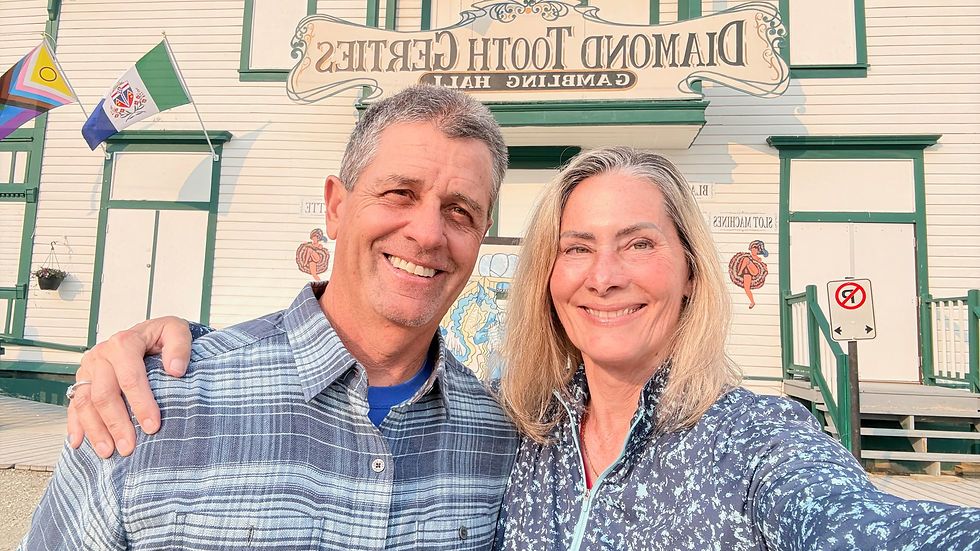
The next morning we pointed the truck back toward Dawson City.
The return drive wasn't nearly as magical.
Rain and fog settled over the mountains, hiding many of the spectacular views we'd enjoyed the day before.
It made us appreciate just how fortunate we'd been to experience the T
op of the World Highway under blue skies.
Would we recommend it?
Absolutely.
Would we take our forty-four-foot motorhome over it?
Not a chance.
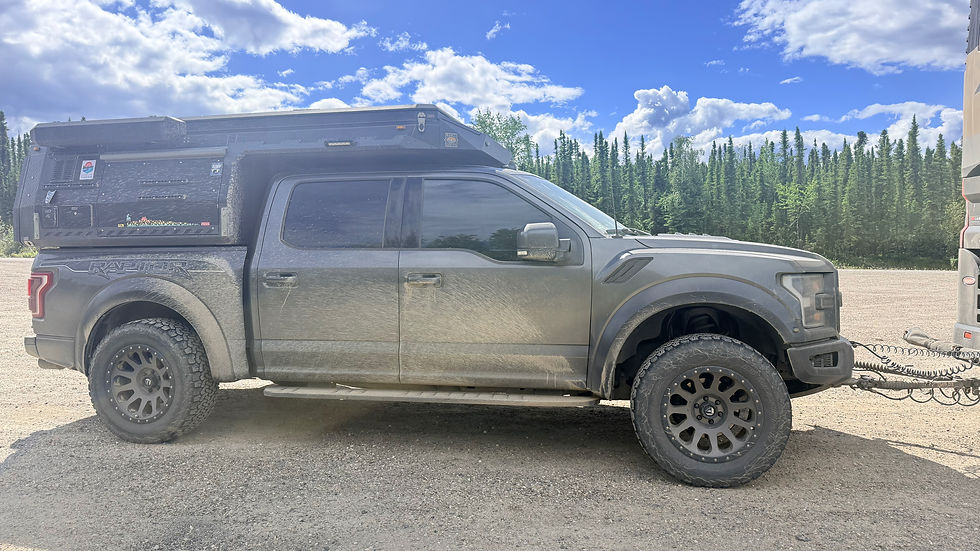
The Raptor was perfect.
Paired with our truck camper, it gave us the freedom to pull into every overlook, explore side roads (well...at least once), and simply enjoy one of the most unique drives we've ever experienced.
Some roads take you somewhere.
The Top of the World Highway is one of those rare roads where the drive itself is the destination.
Tombstone and the Dempster Highway

Before leaving Dawson City, we had one more adventure waiting for us.
Like the Klondike Highway and the Top of the World Highway before it, the Dempster Highway came with plenty of warnings. Mud. Dust. Flat tires. Endless potholes. We weren't planning to drive all the way to the Arctic Ocean—this time, at least. Our goal was Tombstone Territorial Park. We wanted to experience the dramatic change in landscape, see the jagged peaks, and finally stand among the permafrost we'd read so much about.
That adventure deserves a story of its own.
Read our Tombstone Territorial Park blog here: Tombstone Territorial Park – Sometimes you have to work with the what Mother Nature gives you!
Spoiler alert: yes, the road was muddy, rainy, rough in places...but it still wasn't as bad as the road from Whitehorse to Dawson.
That comparison became has become our unofficial measuring stick for the rest of the trip and likely beyond.
Back to Whitehorse - braving the return trip
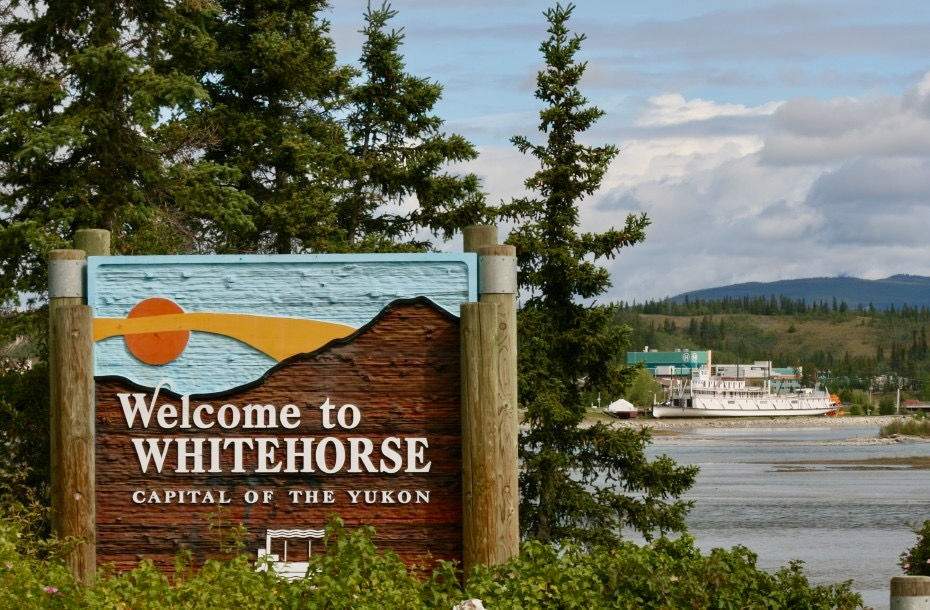
Eventually it was time to head back to Whitehorse.
Whitehorse had become more than just another stop on the map. It was the crossroads of the Yukon. Every major adventure seemed to begin—or end—there. This time it would be our launching point for Haines Junction and eventually Haines, Alaska.
First, though, we had to survive the Klondike Highway one more time.
After spending nearly a week in Dawson City, we secretly hoped the road crews had made at least a little progress.
Manny decided there was no sense stopping halfway this time. If we were going to tackle the rough sections again, we might as well get through both of the worst construction zones in a single day.
Fortunately, our timing couldn't have been much better.
The road was still rough. The potholes were still there, and the frost heaves still demanded your full attention. But fresh gravel had been spread over many of the worst washboard sections, and some of the deepest ruts had been smoothed out.
It wasn't perfect.
It was, however...
better than expected.


Comments